


To link to this article from your blog or webpage, copy and paste the url below into your blog or homepage.
War
an article by our site
Regardless of the world’s moves towards disarmament, the risk of nuclear war is increasing, and nuclear technology is spreading to regions where political instability is high and the mental abilities of leaders to understand themselves, their countries, the world, or the potential impact of nuclear conflict is in serious question. North Korea is a case in point.
The overkill in existing superpower arsenals is ludicrous. What is the reason we need to be able to kill the whole world several times over? No sane world would tolerate such a situation.

Nuclear technology is spreading to regions where political instability is high and the mental abilities of leaders are tiny
New developments in nuclear weapons make them more accurate, enabling military installations to become targets. So the issue these days is not the number of nuclear weapons, but how much "better" today's are. Most "disarmament" measures foster immediate replacements by much more lethal arsenals.

9/11 terrorist attack
On a typical day, there are 12 wars being waged, and it is getting worse. And the casualties are no longer limited to the military as they were before World War I. In World War I, 95 percent of casualties were military; but in today’s wars, 60 percent of the casualties are civilian. The 9/11 attack casualties were all civilian.
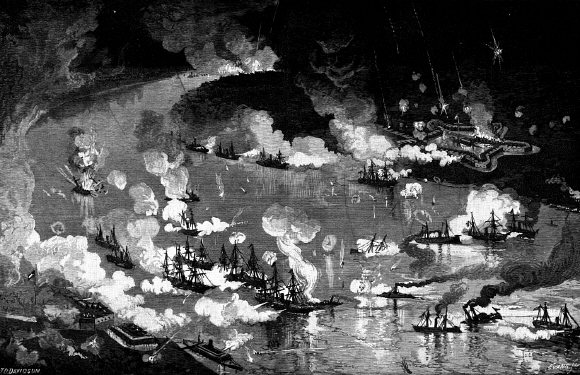
On a typical day, there are 12 wars being waged, and it is getting worse
And of course religious "causes" are at the heart of most battles. The Middle East is a hotbed of religious conflict—whether Moslems against Jews, or Sunni Moslems against Shiite Moslems, or Americans against terrorists. In this area of the world particularly, religion is almost always the stated reason for war.

Religious 'causes' are at the heart of most battles
"The American role in the New World Order will ultimately be determined by economic constraints. The growing vulnerability of the U.S. economy, its dependence on foreign capital, its failure to invest in roads, bridges, schools, and civilian technology are now taking such a dramatic toll on civil society that unless the investment priorities are radically changed, American influence will inevitably decline." (Source: Harper's Magazine, May 1991, pp. 63-64.)
The United States is the only advanced nation without any decent and comprehensive national health insurance. The United States has the highest percentage of its population behind bars of any nation. And it has a murder rate unequaled by any country. Also, we can only borrow so much money before lenders refuse to lend. Apparently our leaders see more sense in borrowing than in getting our act together so we need not be borrowing so irresponsibly.

The doomsday clock is currently set at 3 minutes to midnight

Unless American citizens start defecating money, the debt has put us all in deep doo-doo

The United States has the highest percentage of its population behind bars of any nation
President Bush noted in his victory speech to Congress that during the one hundred hours of the ground war more Americans were killed by gunfire on our city streets than in the Gulf War theater of operations. The afterglow of victory is not enough to restore our country's social fabric or lessen the social symptoms, and as the social fabric weakens so does the real power of the United States to influence the world. For the crucial battles of the new century, our industrial competitors concentrate on their economic bases, while the United States, seemingly unable to understand the shifting foundations of national power, risks being caught in a time warp of an American century that is long gone. In desperate need of Third Wave thinking, the country stays mired in Second Wave thinking as China and Japan surge ahead. Orientals tend to think long-term, while Americans try only to please stockholders at the next meeting.

(Source: http://filipspagnoli.wordpress.com/stats-on-human-rights/statistics-on-war-conflict/statistics-on-arms-trade/)
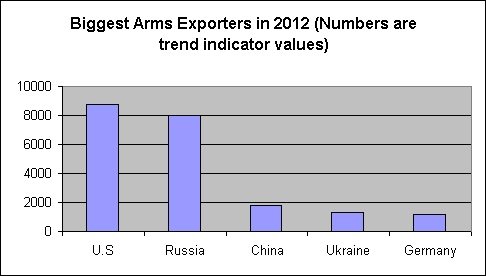
(Numbers are trend indicator values only, not money or drug tonnage) (Source: http://en.wikipedia.org/wiki/Arms_industry Arms Industry)
And though politicians pay lip service to a less-armed world, what they say is not what they do. President Bush, after the Gulf War, called for restraint on weapons proliferation in the Middle East. The result? $7 billion in advanced weapons were sold or given to middle-east allies; in addition, $1.6 billion to Egypt, $1 billion to Saudi Arabia, plus logistical support, bombs, et al., $682 million to the UAR; and the United Nations Security Council big-5 meeting about Middle East arms control made no changes in conventional weapons proliferation. (Source: Jennings, Peter, "A Line in the Sand, What Did America Win?" ABC News Special, September 12, 1991.)

Iraq + Afghanistan Wars—6,717 U.S. dead: but for WHAT?
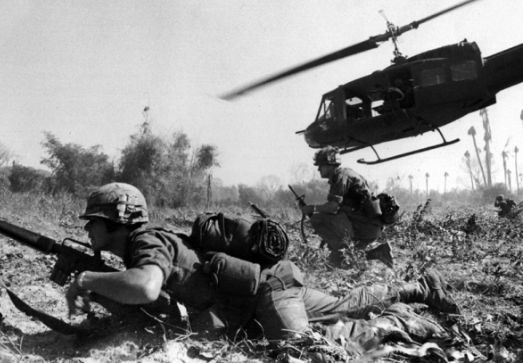
Vietnam War—58,209 U.S. dead: but for WHAT?
It’s time to stop wasting tax revenues on expensive weapons systems that are mostly needed to boost the profits of the corporations who build them. . . . It’s time to redirect our resources to meet human needs. It’s time to bring the war dollars home. (Source: Paying for America's War Machine Is a Terrible Waste of Tax Money)