


To link to this article from your blog or webpage, copy and paste the url below into your blog or homepage.
Arms and Drug Trade
an article by our site
About 12,000,000,000 bullets are produced every year—nearly enough to kill everyone on earth twice. In fact, every minute, one person is killed by armed violence. There are almost 1 billion guns in the world. About a quarter billion of these are in the U.S. Bullets waste a lot of copper, lead, zinc, and steel, and the lead contaminates the environment.
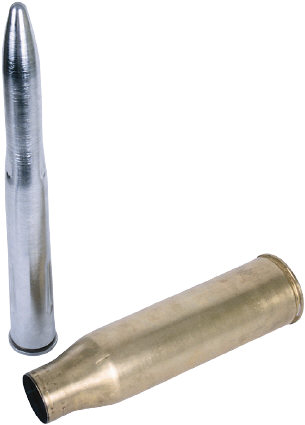
About 12,000,000,000 bullets are produced every year—nearly enough to kill everyone on earth twice
Of the 4,000,000 war-related deaths in the 1990s, 90% were civilian and 80% of those deaths were women and children. If this was supposed to be accomplishing or solving anything, why does it keep happening and why is it getting worse? Is the world insane?! Or just the leaders?

If massive war killings were supposed to be solving anything, why do they keep happening?
When we look at the huge arms trade profits, we have to ask ourselves just how much of the armed disputes on Earth are dispute caused, and how much are artificially provoked by various countries stirring up trouble so that they can profit from the arms trade. The U.S. has often profited by arming BOTH sides of wars and so has Russia and China, but the U.S. is the biggest arms exporter of all. It makes one think (and cringe). Five of the six biggest arms producing companies on earth are in the U.S.

(Source: http://filipspagnoli.wordpress.com/stats-on-human-rights/statistics-on-war-conflict/statistics-on-arms-trade/)
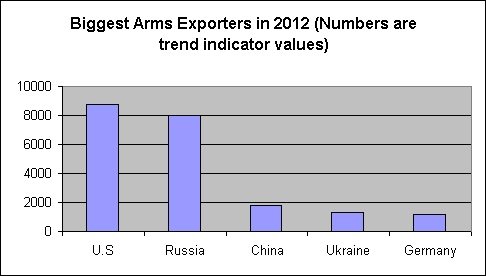
(Numbers are trend indicator values only, not money or drug tonnage) (Source: http://en.wikipedia.org/wiki/Arms_industry Arms Industry)
The U.S., Russia, China, Ukraine, and Germany, in descending order, are the biggest arms exporters.
Although Western (developed) countries pat themselves on the back regarding the aid they provide to developing countries, developed countries spend more on the military than on they spend on their own health or their own education. Huge military expenditures have adverse consequences on domestic economies—employment, productivity, inflation—and also lessen the money that is available for foreign economic aid.
In developing countries, the use of scarce money to buy weapons is an incredible waste. It fuels debt, leads to adverse balances of payment, and so seriously hampers development. And the trend is accelerating, with many poor countries devoting a substantial and increasing fraction of their budgets to the military.
The world spends more on the military than the poorer half of humankind earns. And political leaders tolerate this waste because they fear loss of office if they try to stop it. (Source: The Gaia Peace Atlas, Survival into the Third Millennium)
In addition to their spending on armaments, the Southern nations are inexorably tied into the international drug market.

Drug abuse on a large scale seriously undermines the morals of society and threatens its values
In addition to the obvious security risks of acquiring weapons from illicit drug dealing, there are the effects of drug abuse on society to consider. Drug abuse on a large scale seriously undermines the morals of society and threatens its values. Violent crime is also intensified by large-scale dealing because of the weapons connection. Los Angeles youth gangs dealing in crack use handguns and sometimes even assault rifles, which are gained from transactions with arms smugglers.
Drug trafficking provides some developing countries with a significant fraction of their GNP and the livelihood of many communities, though governments may not be directly involved. It is very difficult to produce transnational control of an activity that benefits some of the parties.
A UN report said "the global drug trade generated an estimated US$321.6 billion in 2003." With a world GDP of US$36 trillion in the same year, the illegal drug trade may be estimated as slightly less than 1% (0.893%) of total global output. Consumption of illegal drugs is widespread globally. (Source: http://en.wikipedia.org/wiki/Illegal_drug_trade)
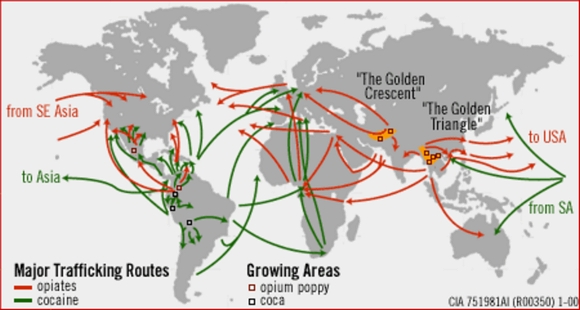
International drug routes in the 21st century (Source: CIA)